



Recreational Marijuana in General
Q: What is the purpose of legalizing recreational marijuana?
A: As stated in Measure 91, the purpose of the Act is to:
Q: What does Measure 91 do?
A: Measure 91 allows Oregonians to grow limited amounts of marijuana on their property and to possess personal limited amounts of recreational marijuana for personal use beginning July 1, 2015 under Oregon law. The measure also gives OLCC authority to tax, license and regulate recreational marijuana grown, sold, or processed for commercial purposes. The OLCC does not regulate the home grow/personal possession provisions of the law. The OLCC will begin accepting applications for growers, wholesalers, processors and retail outlets on January 4, 2016
Q. When will Measure 91 go into effect?
A. The home grow/personal possession provisions of the measure start on July 1, 2015.
However, the OLCC won’t begin accepting license applications from those who want to commercially grow, process, wholesale or operate retail marijuana outlets until January 4, 2016. The ability to buy marijuana at a retail outlet is not expected to start until the fall of 2016.
Q. Who will implement the initiative?
A. The initiative designates the Oregon Liquor Control Commission as the state agency that will regulate the commercial growing and selling of recreational marijuana. It also gives the OLCC authority to tax, license and regulate commercial recreational marijuana operations. The OLCC has no authority to regulate or enforce the home grow/personal possession provisions of the law.
Q: How can I get a job with OLCC in the new marijuana program?
A: OLCC posts job opportunities on the www.oregonjobs.org website. Interested applicants can fill out a Job Interest Card to receive email alerts about job openings at OLCC. You can also sign up for email alerts about OLCC job opportunities through our website.
Q: Can Measure 91 be changed?
A: Yes. Since the measure is a statutory one instead of constitutional, any of its provisions can be changed by the Oregon Legislature, which is currently in session and will be until July 11, 2015. The measure cannot be changed by the OLCC’s rule making process.
Q: Where can I get more information?
A: As updates occur and information is available, we will share that information with you on this website. To keep up to date, click here.
Q: What if I have additional questions?
A: Please send additional questions to marijuana@oregon.gov.
Back to Top
Medical Marijuana
Q. What impact does Measure 91 have on the current Medical Marijuana Program?
A. None. Measure 91 states that the “Act may not be construed … to amend or affect in any way the Oregon Medical Marijuana Act.”
Q. Should I get a new OMMP card or renew my existing Card?
A. Only you as an individual can determine answer that question. The OLCC cannot advise you about if or how to make that determination.on this matter.
Q: What is the difference between recreational marijuana and medical marijuana?
A: Medical marijuana is for patients with qualifying medical conditions. Recreational marijuana, whether grown at a residence or obtained from a licensed retail outlet, is for personal use for adults 21 years of age or older. For more information on medical marijuana see www.mmj.oregon.gov.
Personal Use
Q: When can I smoke/use recreational marijuana?
A: Starting July 1, 2015, Measure 91 allows Oregonians to grow up to four plants on their property, possess up to eight ounces of usable marijuana in their homes and up to one ounce on their person. Recreational marijuana cannot be sold or smoked in public. Until then, current marijuana laws in Oregon remain in place. Measure 91 requires OLCC to begin accepting license applications by January 4, 2016 for commercial growers, processors, wholesalers and retailers.
Q: Where and when can I buy marijuana?
A: Marijuana will be available for purchase through retail stores licensed by the OLCC sometime in the third quarter of 2016.
Q: Where and when can I buy edibles and extracts?
A: The OLCC has made the decision to take extra time to make sure that it gets the availability of edibles and extracts right. They will eventually be available at retail outlets licensed by the OLCC, but probably not at the same time that the stores are expected to open in the third quarter of 2016.
Q: How much marijuana can I have?
A: Beginning July 1, 2015, recreational marijuana users can possess up to eight ounces of useable marijuana and four plants per residence in Oregon. An individual can carry up to one ounce in public, but smoking using marijuana in public is prohibited.
Q: What is meant by “useable” marijuana?
A: Useable marijuana refers to dried marijuana flowers or leaves. In other words, marijuana that is ready to smoke.
Q: Can I grow marijuana at home and when?
A: Yes, with limits. The act allows home grow of up to four plants per residence beginning July 1, 2015, regardless of how many people live in the residence. Four adults in one residence does not mean 16 plants. The limit is four per residence.
Q: Where can I obtain marijuana seeds or starts after July 1, 2015?
A: The OLCC can provide no guidance on that issue.
Q. Can a landlord tell tenants not to grow recreational marijuana or smoke it rental units?
A. Measure 91 does not affect existing landlord/tenant laws.
Q: What if an employer requires drug testing?
A: Measure 91 does not affect existing employment law. Employers who require drug testing can continue to do so.
Q: Can I smoke marijuana in a bar/restaurant?
A: No. Marijuana cannot be smoked or used in a public place.
Q: What is the definition of a public place?
A: Measure 91 defines a public place as “a place to which the general public has access and includes, but is not limited to, hallways, lobbies, and other parts of apartment houses and hotels not constituting rooms or apartments designed for actual residence, and highways, streets, schools, places of amusement, parks, playgrounds and premises used in connection with public passenger transportation.”
Q: Who can smoke recreational marijuana? What is the minimum age?
A: As of July 1, 2015, anyone 21 years of age and old and consume recreational marijuana in Oregon. Marijuana use or possession of recreational marijuana by anyone under 21 years of age is illegal. That includes home consumption.
Q: Who will enforce recreational marijuana laws?
A: Enforcement of the home grow/personal possession provisions of Measure 91 will be at the discretion of local jurisdictions, the state police and possibly other law enforcement agencies. The OLCC is responsible for enforcement actions against businesses that the OLCC licenses to grow, process, wholesale and sell recreational marijuana and related products.
Q: How much will recreational marijuana cost?
A: The retail price of recreational marijuana will be determined through a competitive marketplace.
Q: Can Oregon recreational marijuana be taken to the state of Washington where it is also legal?
A: No. Taking marijuana across state lines is a federal offense.
Q: How will children be protected from recreational marijuana and marijuana products?
A: Measure 91 prohibits the sale of recreational marijuana to anyone under the age of 21. The act also gives OLCC authority to regulate or prohibit advertising. In writing the rules necessary to implement the new law, the OLCC may also regulate packages and labels to ensure public safety and prevent appeal to minors.
Q: Can I get a DUII while under the influence of marijuana?
A: Yes. Current laws for DUII have not changed. Driving under the influence of intoxicants (DUII) refers to operating a motor vehicle while intoxicated or drugged, including impairment from the use of marijuana. In addition, Measure 91 requires OLCC to examine, research and present a report to the Legislature on driving under the influence of marijuana. The OLCC will do this in conjunction with the Department of Justice Criminal Investigation Division and Oregon State Police.
Q: Can I lose my job for using marijuana?
A: Passage of measure 91 does not change existing employment law in Oregon.
Q: Where will marijuana stores be located?
A: Measure 91 does not address siting requirements. Where to locateLocation of commercial recreational marijuana businesses will be determined by legislative action, location local action or through the OLCC rule-making process. To keep up to date, click here.
Q: Who collects the tax on recreational marijuana?
A: Under the provisions of Measure 91, the OLCC is required to collect the tax on recreational marijuana at the grower level.
Q: How is Washington state’s recreational marijuana law different than Oregon’s?
A: See Oregon/Washington/Colorado Comparison
Licensing
Q: What licenses will be available?
A: The measure lists four types of recreational marijuana licenses: Producer, Processor, Wholesaler, and Retail. A producer is also known as the grower. A processor is a business that will transform the raw marijuana into another product or extract. Processors are also responsible for packaging and labeling of recreational marijuana. A wholesaler is a business that buys in bulk and sells to resellers rather than to consumers. A retailer is a business that sells directly to consumers.
Q: When will the OLCC begin accepting license applications?
A: The measure requires OLCC to begin accepting license applications for recreational marijuana by January 4, 2016.
Q. How will OLCC decide who gets ato grant or deny license applications?
A. Undetermined at this point. The OLCC is in the process of writing the rules necessary to implement Measure 91. The agency has appointed an advisory committee that will write the rules and send its recommendations to the Commission sometime this fall for approval.
Q. If I want to apply for a recreational marijuana license, what should I do now?
A. Be patient. The OLCC won’t be accepting applications until January 4, 2016. In the meantime, to keep up to date on process, click here.
Q: How much are the licensing fees?
A: Measure 91 establishes an annual license fee of $1,000 plus a non-refundable application fee of $250 per license application.
Q: How many licenses can I have?
A: A licensee may hold multiple licenses and multiple license types.
Q: Can an out-of-state resident hold an Oregon recreational marijuana license?
A: Measure 91 does not specifically address this question. However, the issue of residency will may be addressed by either the Oregon Legislature or by the OLCC through the rule-making process.
Q: Who will be eligible for a marijuana license?
A: Anyone over 21 years of age and older will be eligible for a recreational marijuana license if they meet certain conditions outlined in section 29 of Measure 91.
Under those conditions, the OLCC may refuse a license if it believes the applicant:
Q: What if my city/county wants to go “dry?”
A: Measure 91 states that local governments may not prohibit licenses in their jurisdiction except with a vote at a general election. Measure 91 allows local governments to adopt reasonable time, place and manner restrictions to regulate public nuisance.
Q: What kinds of testing will OLCC require?
A: Undetermined at this point. Under Measure 91, the OLCC has the authority to set testing requirements, but this is a policy question that will be determined during the rule-making process, including legislative and public input.
Retail Stores
Q: When will marijuana stores be open?
A: Undetermined at this point, but the most likely time is during the third quarter of 2016.
Q: Will the OLCC distribute marijuana out of a central warehouse?
A: No. Measure 91 clearly states that the OLCC “has no authority to purchase, own, sell or possess any marijuana items.” The OLCC’s primary responsibility is to collect taxes and to license and regulate producers, processors, wholesalers, and retailers.
Q: Will there be a quota for how many retail outlets will be allowed?
A: The measure does not specifically address the number of retail outlets allowed. Specifics for licensing retail outlets will be part of the rule-making process that is currently underway.
Q: What will OLCC be doing to get ready for marijuana-related businesses?
A: The OLCC has held listening sessions throughout the state to gain a better understanding of what Oregonians expect in the implementation of Measure 91. In addition to getting legislative approval of the marijuana budget for 2015-17 and preparing to hire staff for the program, the OLCC has also selected a vendor to build the online application process and finding a second vendor for the traceability (seed-to-sale) system to track recreational marijuana. The OLCC has appointed an advisory committee to help write the rules necessary to implement Measure 91 and several subgroups to address specific issues. The goal is have the rules adopted by October or November of this year, after which the agency will hold seminars around the state to familiarize people with the application process in advance of accepting applications on January 4, 2016.
Taxes
Q: How much are the taxes?
A: Measure 91 provides for an excise tax that is paid by the producer (grower) of $35 per ounce for flowers, $10 per ounce for leaves, $5 per immature plant.
Q: How much money will marijuana bring in taxes?
A: In its 2015-175 requested budget for the marijuana program, the OLCC estimated revenue for the two-year period to $18.4 million. That revenue would come from application and licensing fees and the sale of recreational marijuana.
Q: Where will the tax money go?
A: Measure 91 provides distribution of revenue after costs to the following:
We are excited to be back in Portland on 5/16 & 5/17 to teach the latest things written into Measure 91 with local cannabis attorney Paul Loney from oregonmarijuanalaw.com
Enroll at https://oregon.cannabis.institute.420college.org
 Back in 1998, Oregon legalized medical marijuana for patients of certain conditions where they could be recommended weed to help alleviate the symptoms of the condition.
They were granted the right by this legislation to be able to own and grow a certain amount of marijuana plants, but what happens with the people that are not really able to grow their own? The laws have recently changed to allow for dispensaries in the state to operate to fulfill this need. Asking yourself how to open a cannabis dispensary in Oregon now that it’s becoming a legal reality?
It may seem overly complicated to try to get your paperwork and everything in order to open your own dispensary as everyone knows that government regulated industries can be hard to get into. 420 College exists for the purpose of helping you achieve your dream of business ownership by giving you in-depth information on the process of getting started in the industry.
There are a variety of options that they offer to assist your business from help with specific tasks, such as paperwork, to a marijuana business seminar that covers all aspects of the business. This seminar is a great option for people that are thinking of getting involved with the industry, but are not completely sold on if this is the best business model for them.
Experts are available to go over the different facets of opening a dispensary from start to finish. Learn about accounting, insurance, banking, rentals, cultivating, legal issues and more from experienced experts as this industry is not exactly the same as any other business that you could open. There will be lawyers, accountants and other professionals that you can interact with, and learn from about this exciting opportunity.
No longer wonder how to open a cannabis dispensary in Oregon, but get yourself educated on the ins and outs of the business. It can seem to be overwhelming when trying to get all set up by yourself, but you do not have to do this alone. It is important to take advantage of any opportunity that will make things easier, and in this case, that would be attending this seminar.
 You can learn the about how to open a cannabis dispensary in Oregon and the answers to all of your questions in our next seminar in Portland.
Oregon Cannabis Institute with attorney and industry professionals and will be hosting this live seminar to go over all aspects of marijuana business operation.
At OCI – it all begins with helping YOU to understand what is proper, lawful and appropriate!
Our hands on marijuana business start-up seminars are perfect way to learn how to start a business following all Oregon HB 3460 laws. You get an intense day of advanced information about how to start and operate a cannabis business. Find out how, click here for more information.
The OLCC is seeking a full-time Compliance Specialist 3 (Program Compliance Specialist) with the Marijuana Program.
The purpose of this position is to develop the standards and procedures for licensing and regulating marijuana businesses in Oregon. This position also trains and oversees the work of the marijuana regulatory staff, evaluates the effectiveness of the licensing and compliance functions, and conducts investigations on the most complex or sensitive cases.
View the complete job description, qualifications, and details on how to apply.
Closes April 12, 2015.
The OLCC is seeking a full-time Administrative Specialist 1 (Program Assistant) with the Marijuana Program.
The purpose of this position is to coordinate the administrative needs of the marijuana program including developing office and operational procedures and materials. It also meets administrative needs by compiling and evaluating information, drafting and reviewing documents and policies, and triaging department inquiries.
View the complete job description, qualifications, and details on how to apply.
Closes April 10, 2015.
OLCC signs contract for online marijuana licensing
 PORTLAND, Ore. – The Oregon Liquor Control Commission has signed an agreement to build the online application necessary to handle requests for commercial recreational marijuana business licenses.
Under the measure approved by voters last November to legalize recreational marijuana, the OLCC has a deadline of January 4, 2016, to begin accepting applications for commercial growers, processors, wholesalers and retail outlets.
Under the agreement, NIC USA, Inc. will build a secure online application that will be used by recreational marijuana license applicants to apply for a new license, renew an existing one, pay license fees by credit card, pay marijuana taxes in accordance with new law, and update license information.
“The agreement with NIC USA is an important step on the path to getting the marijuana program up and running by January of next year,” said Tom Towslee, acting communications director for the OLCC. “The next step is to appoint a rules advisory committee to help write the rules necessary to implement the new law.”
The application design will begin immediately and be completed in time to meet the statutory deadline of Measure 91. The agreement has an annual subscription fee of $80,000 and no up-front costs.
NIC USA, Inc. manages, markets and operates the E-GOV Program web portal for the State of Oregon, under a master agreement that the Department of Administrative Services administers.
Greetings!
Due to a technical problem you may have not been able to access the entire recorded audio from the OLCC’s February 26-27 Commission meeting. The complete audio files are now available.
OLCC Commission Meeting Calendar
Marijuana Business Paperwork
 Anyone who is looking to open a marijuana business in Oregon must understand that the Measure 91 marijuana business paperwork could be a complicated thing. The business is quite risky, but in addition, there are strict rules to follow when it comes to setting up dispensaries in the state. The reason the state laws are strict is to prevent unnecessary and lower grade applications. It is not possible for just anyone to submit an application because of a number of reasons.
First of all, Measure 91, Oregon marijuana business paperwork might not be easy to handle. You may require the help of a lawyer to take care of the cannabis business paperwork. Another reason is that you require huge amounts of money to set up such a business.
You need to rent a suitable place where all the transactions and handling of marijuana will take place. All the staff members will be required to undergo background checks and you will have to secure a bond of few millions of dollars to be able to proceed with your application. Obtaining the necessary permits and licenses is another hectic task to take care of. Just some of the minor things that have to be done.
You can learn the about the marijuana business paperwork in Oregon and the answers to all of your questions in our next seminar in Portland.
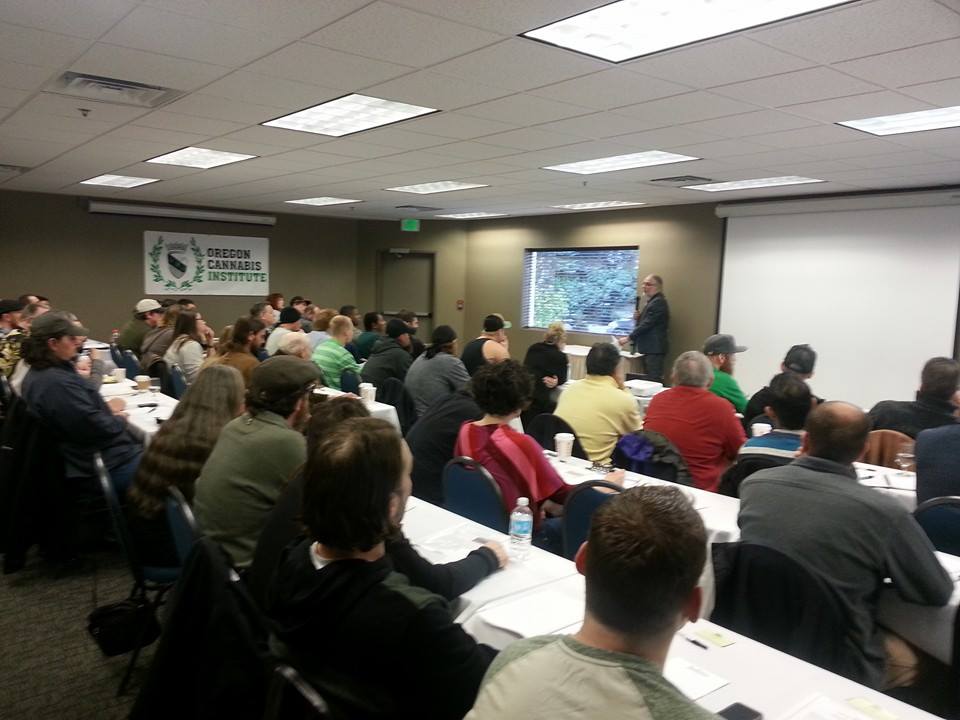 Oregon Cannabis Institute with attorney and industry professionals and will be hosting this live seminar to go over all aspects of marijuana business operation.
At OCI – it all begins with helping YOU to understand what is proper, lawful and appropriate!
Our hands on marijuana business start-up seminars are perfect way to learn how to start a business following all Oregon HB 3460 laws. You get an intense day of advanced information about how to start and operate a cannabis business. Find out how, click here for more information.
 If you are looking to obtain a clear understanding of how to start a marijuana business and how to run a marijuana business, it is essential that you get enrolled in a cannabis college. There are many marijuana colleges which offer courses to individuals who want to get the marijuana industry. Since this marijuana industry is quite lucrative, there are many people who want to become a part of it. But unfortunately, the state laws are quite strict and it is not possible for just anyone to start selling marijuana. Applicants must meet strict legal requirements before they are selected. This means applicants must learn everything about the business before they take a step further or even think about submitting their application.
By attending a cannabis college, you can improve your chances of getting selected. You can get specific information on how to set up a marijuana business and operate a marijuana business successfully. A marijuana business is not like any other business. the rules are very strict and when you attend a marijuana college, you will not only learn about the business opportunities the marijuana industry will bring, but you will also get to interact with professionals who have experience in this industry. You can get regulatory and legal updates about what is currently happening, what is going to happen and what is required of you.
You can learn the about the cannabis college in Oregon and the answers to all of your questions in our next seminar in Portland.
Oregon Cannabis Institute with attorney and industry professionals and will be hosting this live seminar to go over all aspects of marijuana business operation.
At OCI – it all begins with helping YOU to understand what is proper, lawful and appropriate!
Our hands on marijuana business start-up seminars are perfect way to learn how to start a business following all Oregon HB 3460 laws. You get an intense day of advanced information about how to start and operate a cannabis business. Find out how, click here for more information.
Portland, OR – At their monthly meeting Friday, January 30, 2015, the Commissioners of the Oregon Liquor Control Commission voted to request that the Legislature give OLCC some kind of peace officer authority in order to adequately enforce the rules under Measure 91.
“We don’t want the agency to be a paper tiger when it comes to enforcing the law,” said OLCC Chairman Rob Patridge.
Agency peace officers would facilitate coordination with local law enforcement on matters ranging from minor decoy operations to criminal investigations. The agency currently employs 45 peace officers in its alcohol public safety division.
The Commissioners also invited representatives from local government and law enforcement as well as experts from the marijuana industry to provide testimony on the implementation of Measure 91, the recreational marijuana law passed by voters in November.
“We heard a lot of unanimity on some key issues,” Patridge said. “Law enforcement, local government and industry agree that we need to ensure that product advertising and packaging does not appeal to minors. And we heard broad agreement that our rules need to establish bright lines for effective enforcement and regulation.”
